An educational intervention to expose and upend victim-blaming. We reveal how victim-blaming questions protect perpetrators and blame survivors. Through exhibits, podcasts, films, and educational work, we document child sexual abuse, domestic violence, and gender-based violence—and the institutional failures that enable these harms.
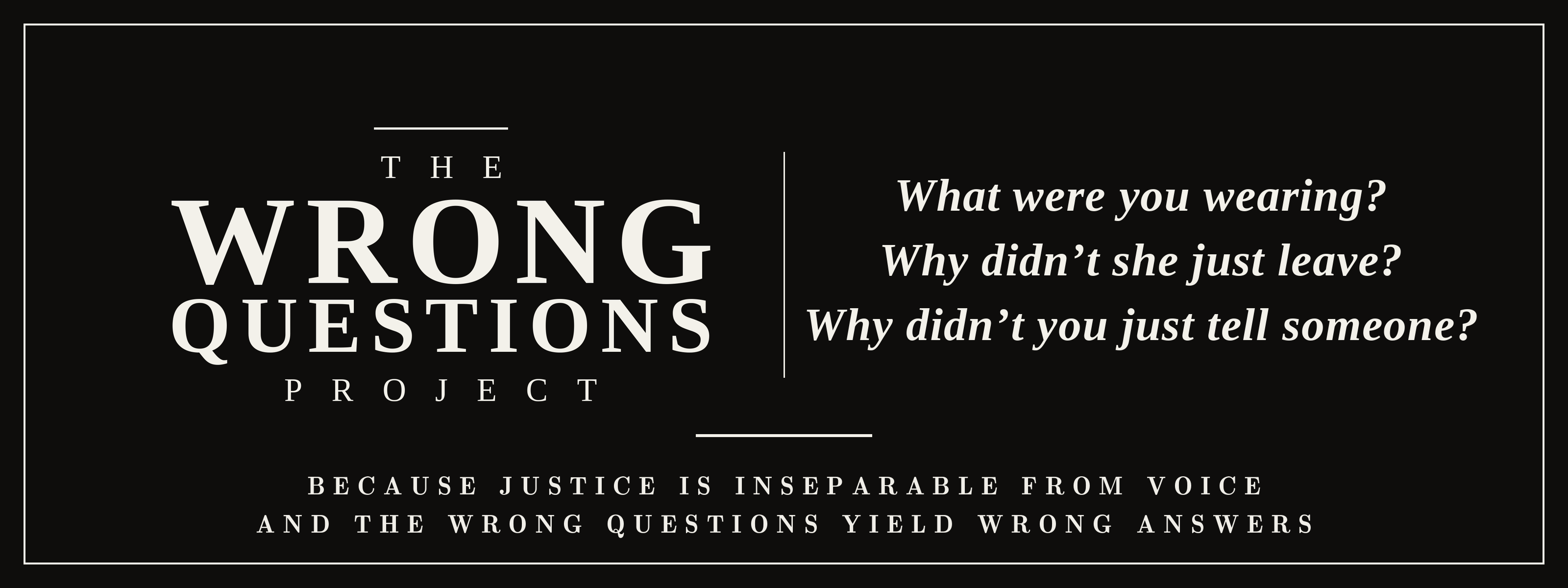
The Wrong Questions Project currently focuses on exposing the realities hiding behind three common victim-blaming questions:
These questions are not innocent curiosities. They are accusations that redirect responsibility from perpetrators to victims, survivors, and families. They make the person harmed answer for violence they did not cause. The Wrong Questions Project reveals how these questions function as tools of institutional disbelief and how they enable violence to continue.
The Wrong Questions Project is a survivor-led, survivor-centred, and surviving-family-centred public arts educational program built on a simple but demanding premise: if we keep asking victims, survivors, and surviving family members the wrong questions, we will keep producing the wrong answers. And the wrong answers do not end violence. They perpetuate and enable it.
The project exposes how victim-blaming questions function as the lexicon of the perpetrator in public form. They appear as curiosity, fact-finding, concern, procedure, or common sense. They are not. They are thinly veiled accusations that relocate the crime into the victim's body, clothing, choices, memory, fear, silence, delay, or attempts to survive. They ask us to account for violence we did not cause.
When the victim does not survive, the questions do not stop. They are redirected toward the people left behind: mothers, fathers, sisters, brothers, children, partners, friends, and loved ones who are made to answer for violence they did not cause and could not have controlled.
The truth is this: it was never our fault. And the wrong questions are dangerous because they yield the wrong answers.
The exhibit modules in The Wrong Questions Project are co-curated and produced by survivors, surviving family members, and professional collaborators, grounding each installation in direct witness, case documentation, and curatorial oversight.
Mary Simmerling, Ph.D.; Suzy Boylan, J.D.; Jen Murphy, enrolled member of the Chippewa Cree Tribe and MMIW/P Project; Denise Huskins Quinn, DPT, and Aaron Quinn, DPT; Nichole Schmidt and Jim Schmidt, of the Gabby Petito Foundation; Justin Bradshaw, Becky Bradshaw, and Angie Giorgis, of A New Dawn: Remembering Macey Dawn; Bevin Llanes, in remembrance of Meghan Kiefer; Chris McGhee; Pennie Nichols, Ph.D.; and Donna Zucker, M.F.A..
Locally hosted exhibits often include local guest curators who are essential partners in this work.
The Wrong Questions Project begins with language because language is one of the first places impunity is built. Language assigns roles, distributes doubt, and offers ready-made scripts for minimizing harm. It is where violence is softened into misunderstanding, where coercion is reframed as conflict, where terror is renamed as volatility, where institutional indifference is treated as neutral, and where victims, survivors, and surviving family members are made to appear responsible for crimes committed by perpetrators.
This project refuses that grammar. It refuses the lexicon of the perpetrator. It refuses the credibility hierarchy that requires survivors to become smaller, calmer, more palatable, and more procedurally acceptable in order to be believed.
The work is not only about what happened. It is about what happens after: who is believed, who is doubted, who is protected, who is silenced, who is made to carry the burden of proof, whose account is treated as knowledge, and whose loved one is made to disappear inside procedure, immunity, misclassification, media narrative, or institutional self-protection.
This is the credibility inversion the exhibits make visible, in plain sight: the survivor is not believed; the perpetrator is. We place the record beside the disbelief—the dashcam footage, the 911 call, the interview, the managed file—so that the inversion cannot hide. We do not argue that it happened. We let it happen in front of you.
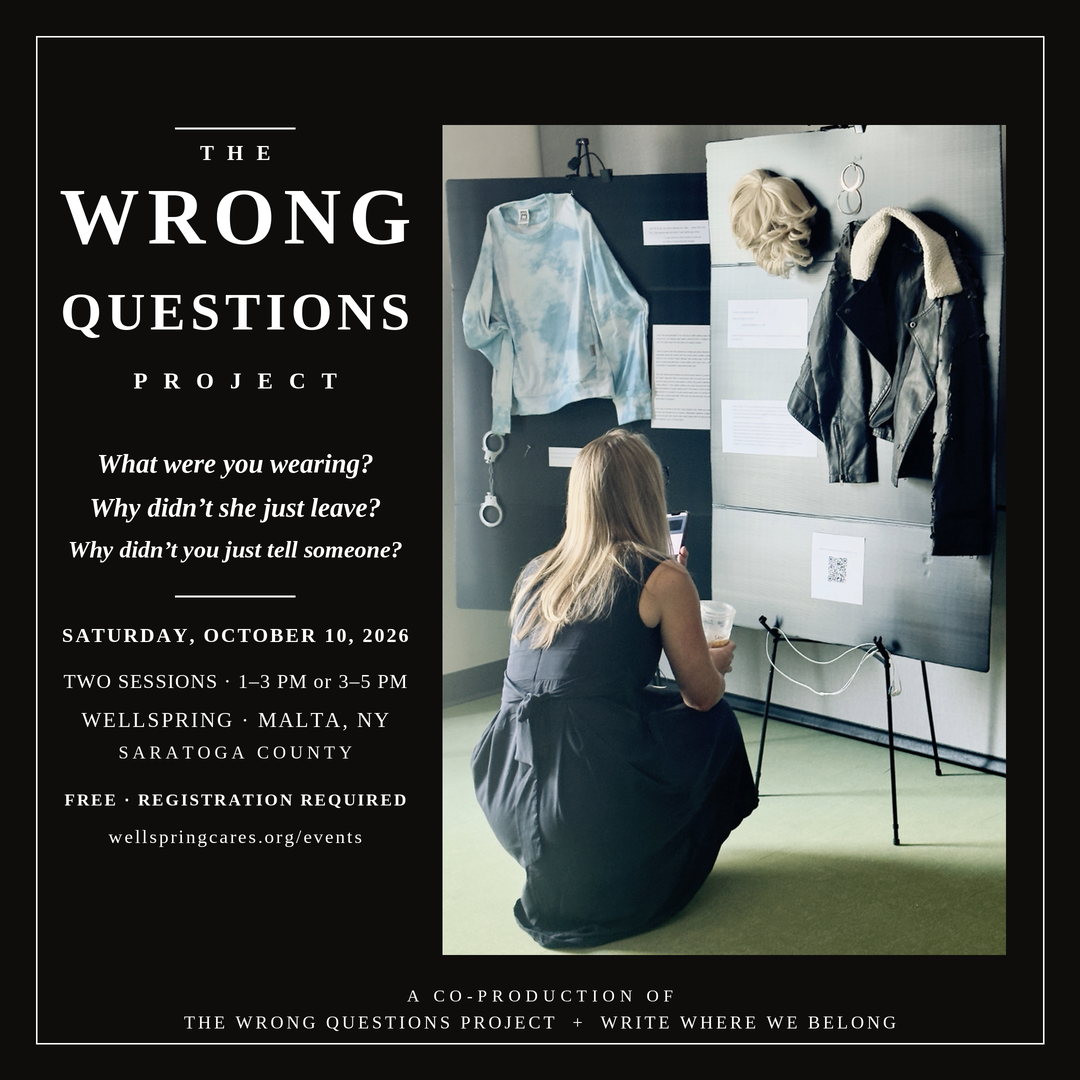
The Wrong Questions Project's signature framework is a modular system of exhibits that can be installed individually, in combination, or as a fully integrated installation. Each module begins with a victim-blaming question and traces how that question functions to blame survivors and enable violence.
The exhibits are not illustrations or artistic interpretations. They are documentation. The clothing, words, objects, statistics, case records, audio, video, testimony, and family witness are part of the evidence. They are placed together so that what has been normalized, minimized, laundered, and administratively absorbed can be seen clearly.
We name deliberately, because the shame was never ours to carry. The fear has always been that a name dilutes the work—that anonymity is what lets a stranger see herself reflected back in an anonymized outfit on the wall. But naming does not narrow it. The name is what makes it possible to say: you are not alone in this.
Through the exhibits and podcasts, we give survivors back their names, voices, and stories. The original installations made the deliberate choice to keep survivors unnamed. We make the opposite, deliberate choice to name survivors and family-led witness as acts of reclamation and moral repair.
The Role of Victim-Blaming & Indifference in Facilitating & Perpetuating Gender-Based Crimes
This module confronts how victim-blaming questions treat clothing as explanation for sexual violence. The question redirects scrutiny from perpetrator to victim, making the person harmed answer for violence they did not cause.
This module pairs survivor words, representative clothing, contextual data, documentary records, and evidence to challenge the false narrative that victims cause, invite, or fail to prevent gender-based violence.
Coercive Control through Language
This module dismantles the question that treats leaving as a simple decision. It documents the violence that makes leaving dangerous: coercive control, stalking, threats, surveillance, and institutional failures that leave women unprotected.
This module centers survivors of domestic violence and surviving family members when violence became lethal, examining not only violence inside relationships but institutional responses: police, courts, custody decisions, media narratives, and institutional refusal to act.
Leaving does not end the danger. It changes it. We see this clearly in so many cases. Jennifer Viater did leave her abusive husband. The Ontario courts ignored her pleas to take action to protect her daughter Keira Kagan from mandated unsupervised visits with her father. The danger moved from Jennifer to her daughter Keira. Keira was found dead next to her father's body at the base of a cliff in a Milton, Ontario in February 2020.
Silencing Children
This module examines how the question fails children by treating silence as the problem rather than examining adults, institutions, and systems that failed to listen, recognize, investigate, intervene, or protect.
This module brings grooming into view—not just of children, but of families and institutions. It examines how authority becomes a grooming environment, how trust is exploited, reputations protected, and access preserved for perpetrators.
When modules are installed together, they amplify one another and reveal the shared machinery: grooming, coercion, silencing, disbelief, institutional failure, credibility policing, victim-blaming, record-management, and the normalization of harm.
Once these patterns become visible in one setting, they become visible everywhere: in police reports, clergy files, hospitals, schools, family courts, custody decisions, media narratives, and the boardrooms where institutions decide whose accounts will be believed and whose will not.
Content Warning
These exhibit storyboards focus on the lived experiences of survivors of sexual and gender-based violence, as well as those who did not survive. They contain depictions and descriptions of sexual abuse, rape, and domestic violence, including assaults involving minors and the murder of women and children. The materials include representations of clothing worn during assaults, survivor testimony, and direct language about violent and traumatic experiences.
YOU ARE NOT ALONE. SUPPORT IS AVAILABLE.
Here's what participants have learned and experienced through engaging with the exhibits:
Among sexual assault response team professionals
The exhibits expose the truth behind the ways indifference and victim-blaming perpetuate and facilitate gender-based crimes. By centering survivor testimony and documentation, the exhibits dismantle the false narratives and questions that protect perpetrators. Participants confront how their own assumptions, institutional procedures, and credibility hierarchies have allowed harm to continue—and are moved to change those systems.
"This was very powerful. It made clear that the questions we ask DO matter and the things we do create stress and trauma between survivors and the responses available. Thank you for sharing this important exhibit."
— Legal Professional
"Wonderful display. I thought of so many things I could change. Our Justice System Needs to Change. They are important. They deserve to be loved & taken care of."
— Institutional Staff
"The exhibit was incredibly powerful. Participants learned a lot and plan to examine their own biases to improve their future professional work with survivors."
— Program Director
"This is incredibly important for 911 training and dispatch. The training approach is phenomenal. The exhibit makes clear that the questions we ask and the things we do create stress and trauma for survivors. All of us—regardless of our role—need to examine the questions we're asking and how we can change our practice. Thank you for this work."
— 911 Trainer
Date
October 10, 2026
Location
Wellspring, 2816 US-9, Malta, NY 12020
Time to follow shortly.
Dates
July 29-30, 2026
Location
Huntington Place, Detroit, Michigan
The Wrong Questions Project offers educational presentations and workshops designed to help institutions, organizations, and communities understand how victim-blaming questions function as tools of institutional disbelief and harm.
For universities, hospitals, law enforcement, and social service organizations seeking to understand how victim-blaming questions and institutional indifference function across their systems.
Duration: 60-90 minutes | Audience: Staff, leadership, and institutional decision-makers
For students, educators, and community members interested in understanding how the infrastructure of disbelief operates and how to build systems that center survivor truth.
Duration: Variable | Audience: Students, educators, community organizations
For professionals in victim advocacy, legal services, trauma-informed care, and institutional accountability seeking deeper understanding of victim-blaming as a systemic practice.
Duration: 90-120 minutes | Audience: Professional practitioners and advocates
We work with institutions and organizations to design presentations that meet your specific needs and context. Contact us to discuss your educational goals.
Subscribe to our YouTube channel to watch documentary films, short videos, and educational content about the victim-blaming questions that fail survivors and perpetuate violence. Our video series brings together survivor testimony, institutional analysis, and documentary evidence.
Each video explores how specific victim-blaming questions function across different forms of violence—child sexual abuse, domestic violence, and gender-based violence—and traces these questions through the institutions and systems that fail survivors.
Visit our YouTube channel to explore documentary films, educational videos, and survivor-centered content that exposes the patterns and architecture of violence.
Our work spans multiple formats to reach diverse audiences:
The Wrong Questions Project podcast will launch in Fall 2026. On it, we will interview survivors and surviving family members to hear from them about their experiences of being asked victim-blaming questions as well as the catastrophic impact that focusing on the wrong questions had in their lives.
Stay tuned for launch details and episodes featuring survivor testimony, institutional analysis, and conversations about justice, voice, and accountability.
We are an educational intervention exposing and upending harmful victim-blaming myths through forensic moral philosophy, art, storytelling, and witness.
Subscribe to our Substack to receive ongoing content and stay connected with our work:
Rape, Abuse & Incest National Network (RAINN) provides free, confidential, and anonymous support 24/7. Call 800.656.HOPE (4673), text HOPE to 64673, or chat at online.rainn.org (available in English and Spanish). The online chat includes a quick-exit feature for safety.
If you are concerned about a child's safety or are a child experiencing abuse, Childhelp provides free, confidential, and professional support 24/7 in over 170 languages. Call 800.422.4453, text GO to 800.422.4453, or use live chat at childhelp.org. Counselors can help with immediate safety planning, resources, and next steps.
If you or someone you love is experiencing domestic violence, help is available right now—free, confidential, and 24/7. Call 1-800-799-SAFE (7233), text START to 88788, or chat at thehotline.org. Trained advocates will help you think through your safety and connect you with local shelters, legal help, and support—with no pressure and no judgment.
The National Center for Missing & Exploited Children (NCMEC) operates the CyberTipline, the centralized U.S. reporting system for online child sexual exploitation, abuse, and trafficking. Report suspected child exploitation at cybertipline.org or call 800.843.5678. Reports are forwarded to law enforcement and child protective services.
Thank you for reaching out.
We've received your message and will respond as soon as possible.
Something went wrong.
Please check your information and try again, or contact us directly.